One of the biggest challenges in LTE overlay deployments is ensuring load balancing to maximize network performance. At EKSPRESA, we have successfully developed this service, and in this article, we will discuss the optimization phase of a network where we implemented this strategy.
The expansion of an LTE network with an additional frequency band, in this case 1900 MHz, is a good example of how post-expansion analysis, monitoring, and optimization are key to ensuring that the installed resources are used effectively.
The fascinating world of radio frequency presents additional challenges because its behavior varies completely from site to site. What has been tested and adjusted at one station will not necessarily be replicated in the same way at another. This is where optimization is necessary to ensure that the network operates as expected and that resource usage is efficient.
What is a PRB?
It is the smallest resource unit that can be allocated to a user.
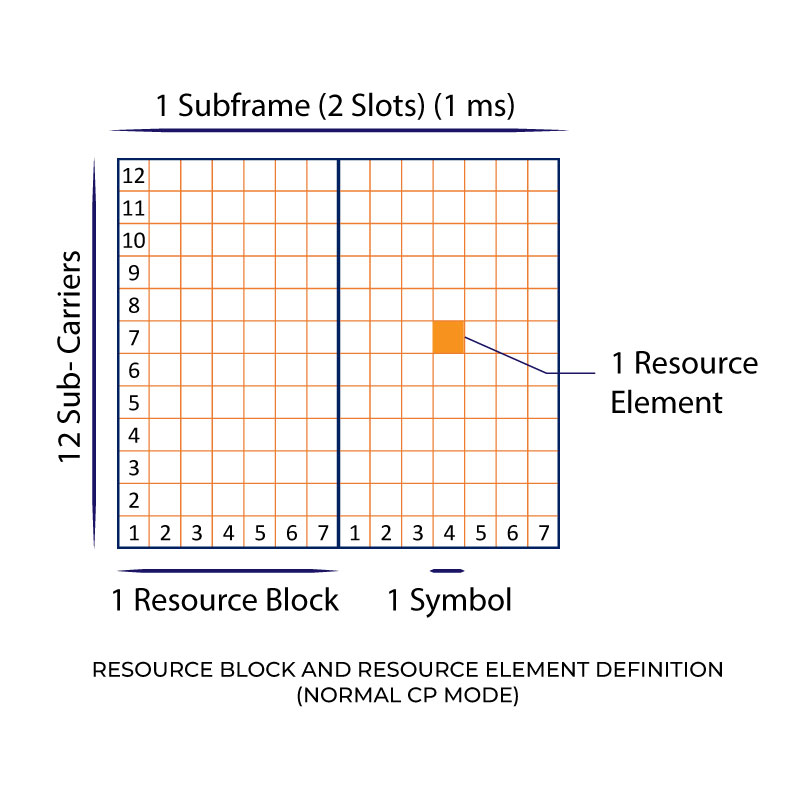
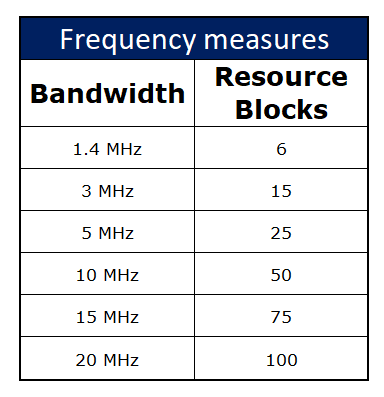
A PRB consists of 12 consecutive subcarriers in a 0.5 ms slot. A Physical Resource Block (PRB) is the smallest provisioning unit in an LTE frame.
For 1 ms, the eNodeB allocates upload or download capacity to a mobile device in PRB units. A transport block is a combination of control and user data, along with forwarding error correction data for a single device, and is allocated to a series of PRBs for transmission.
In general, the greater the allocation of resources, the higher the data speed a user can achieve. For LTE users, the scheduler allocates PRB resources using optimization algorithms. Including PRBs minimizes the peak-to-average power ratio and overall energy consumption.
Since no indicator is considered in isolation, PRB usage must be analyzed in conjunction with the number of connected users, traffic volume, and coverage indicators (poor coverage leads to more PRBs being used for the same user), as shown in Figures 2 and 3.
Importance of PRB Usage Balance in Multi-Carrier Scenarios
Optimizing mobile communication networks is an ongoing task, and proper execution ensures better resource utilization and network operability. However, there is a wide variety of settings that can be configured to achieve the best user experience and efficient resource utilization.
Furthermore, scalability should always be considered when implementing any engineering project. Those of us who work in this field have faced the challenge of considering multiple scenarios and design aspects, only to find that the final solution doesn’t perform as expected once it’s in production. This is part of the engineering and optimization process of any project. How many deployment projects have you faced? How many expansions? Did they turn out exactly as planned?
It’s likely that even in scenarios where different situations have been considered, the execution will fall far short of expectations. In the context of integrating a new carrier into an LTE network to expand the resources available to users, it’s possible to encounter situations where existing KPIs worsen rather than improve, as occurred in the case study presented in this article. Following the integration of a new 1900 MHz LTE network, KPIs such as throughput, % CSFB, and PRB usage declined.
Even when pre-integration KPIs remain unaffected, it’s crucial to optimize the use of installed resources to ensure the best possible experience for the end user.
The Ekspresa RF team not only optimized resource balancing between both bands but also helped improve the operator’s network in the following areas:
- Balance between the use of physical network resources and band usage.
- Improved user experience.
- Maximized return on investment in the network.
- Optimize the handover process within bands and within cells.
- Accommodate a larger number of users without compromising quality indicators.
Case study: Load balancing optimization in an LTE 700 network with a 1900 overlay
In an existing LTE FDD 700 MHz network, expansion was implemented via LTE 1900 MHz with the purpose of moderating the load on the existing band. In the following graph we can observe the behavior of the PRB usage percentage in one of the node sectors after the activation of the new carrier:

Fig. 4 PRB usage after LTE 1900 MHz integration
Once the physical capacity is installed, resources may not be occupied efficiently or may even remain unused. This can be observed in Figure 2, where the use of Physical Resource Blocks (PRB) after the integration of LTE 1900 MHz (orange line) far exceeds that of the existing LTE 700 MHz network (blue line).
This is where the intervention of the EKSPRESA Radio Frequency Engineer begins, in conjunction with the Drive Test field team. Based on collected data, statistics, and experience in optimizing other networks, they proceed to review the algorithms involved in traffic management and channel assignment.
Similarly, efforts were made to align client expectations with the new expansion. The following points were discussed:
-
PRB Balancing will be a requirement at the eNodeB level to optimize access resources from the network’s perspective.
-
PRB usage balancing between bands must be achieved without degrading existing KPIs.
The process to achieve this optimization involved generating mobility algorithms between bands—for both idle and connected modes—as well as PRB load-balancing algorithms.
Different cell-level thresholds were configured and adjusted in a closed-loop implementation, where changes were continuously evaluated and re-implemented. Optimization was confirmed at the cell level two weeks after integration, and at the cluster level one month after all expansions were completed.
It was a significant challenge, as this occurred in parallel with the expansions; the optimization “accompanied” the integration almost immediately. However, EKSPRESA managed to adapt to the client’s proposals, going beyond project expectations and ensuring the best possible use of the installed resources.
Data after PRB optimization in a dual-carrier LTE network
As shown in Figure 5, following the implementation of the optimization algorithms, usage was balanced across both bands. This resulted in the best possible utilization of physical resources for both LTE 700 MHz (blue line) and LTE 1900 MHz (orange line).
 Fig. 5 Network Resource Usage Optimization between LTE 1900 MHz and LTE 700 MHz
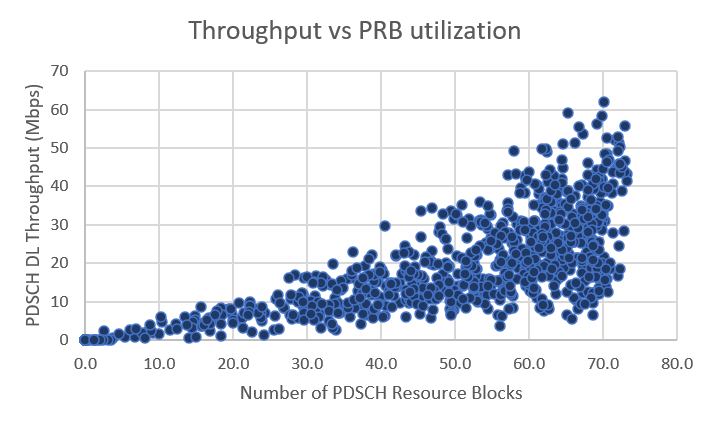
The unique aspect of this type of optimization was precisely its near real-time integration across a large network with a significant number of users, without impacting their experience. Furthermore, it was important to consider that PRB optimization (from a network perspective) doesn’t necessarily run parallel to throughput optimization (from a user perspective); often, attempting to optimize one negatively affects the other. The key was finding the balance that allowed for both simultaneously, as shown in the following graph:

References
Gabriel Ordoñez, Senior Radio Frequency Engineer Ekspresa Panama, 2021-2022.
RFMW, (07-17-2022), LTE Physical Layer Overview. https://rfmw.em.keysight.com/
Samia Dardouri and Ridha Bouallegue, (05-08-2015), Performance Analysis of resource scheduling in LTE femtocells networks. https://www.researchgate.net/